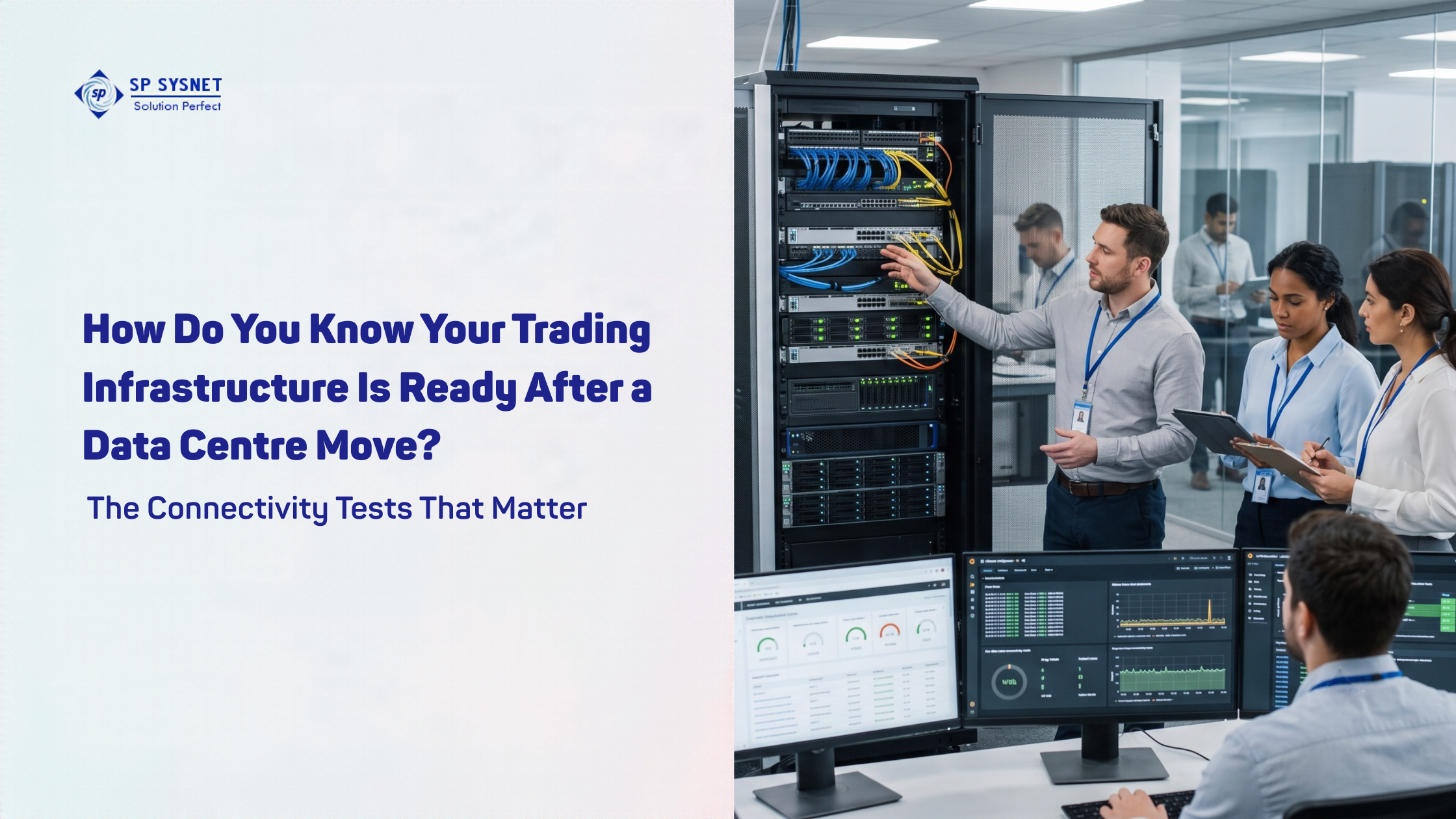

Moving trading infrastructure to a new data centre is a major project. Once servers are racked and cables are connected, it may look like the hard work is finished.
It isn’t.
For trading firms, the real question is whether the infrastructure is actually ready to support production workloads. A server turning on does not necessarily mean the network is performing correctly, market data is arriving as expected, or trading applications can communicate reliably.
This is why connectivity testing should be treated as an essential part of every data centre move.
Start With the Physical Layer
Before testing applications, check the physical infrastructure.
This includes:
- Server and switch connections
- Fiber and copper cabling
- DAC cables
- Optics and transceivers
- Port assignments
- Rack connections
- Power and equipment status
- Cross-connects
A loose connection, incorrect optic, damaged cable, or wrongly patched port can create problems that are difficult to identify later.
For SGX relocations to Keppel DC, documenting the original connections and verifying them after re-racking can make the validation process much easier.
Check Switch and Network Port Status
Once the physical layer is confirmed, the network needs to be checked.
IT teams should verify that the expected interfaces are up and operating at their intended speeds. They should also check VLANs, routing, link aggregation, MTU settings, and other relevant configurations.
The aim is not simply to confirm that the link is “up.”
The question is whether the connection is operating exactly as designed.
Test Connectivity Between Critical Systems
Trading environments usually involve multiple systems communicating with each other.
Market data feeds, trading servers, order management systems, risk systems, monitoring platforms, time servers, and other components may all have dependencies.
Testing should confirm that these systems can communicate correctly after the move.
This is where a clear network map and equipment inventory become extremely useful. Teams can work through critical communication paths instead of relying on basic ping tests alone.
Read More: Why Data Center Management Services Are Essential for Modern IT Infrastructure
Measure Latency and Packet Loss
For a trading environment, connectivity is about more than reachability.
Latency should be measured across important network paths, and packet loss, jitter, and other performance indicators should be checked where relevant.
If latency has increased after a relocation, the team should investigate why rather than assuming the difference is insignificant.
The comparison with pre-move measurements can be particularly useful. Having a baseline makes it easier to identify whether the new environment is performing as expected.
Validate Market Data and Order Connectivity
This is one of the most important stages.
Once basic connectivity has been confirmed, trading teams should verify that market data feeds are being received correctly and that the relevant order paths are functioning.
Depending on the environment, testing may include:
- Market data reception
- Order connectivity
- Feed redundancy
- Exchange connectivity
- Session establishment
- Application-to-network communication
- Failover paths
- Time synchronization
Production readiness should be based on successful end-to-end validation rather than simply checking individual devices.
Don’t Forget Time Synchronization
Accurate time synchronization is particularly important in trading environments.
After moving equipment, teams should verify that servers and relevant network devices are receiving the correct time source and maintaining the required synchronization.
If timestamps are inconsistent, troubleshooting latency and reconstructing events can become much harder.
Test Redundancy and Failure Scenarios
A network can appear perfectly healthy until something fails.
That is why post-move testing should include appropriate failover scenarios.
Can traffic move through the backup link? Does a redundant switch path work? What happens if a primary connection becomes unavailable?
Testing these scenarios before production can reveal configuration problems while there is still time to fix them.
What Does a Proper Trading Infrastructure Check Look Like?
A useful post-move validation process should follow a clear sequence:
- Physical validation
Confirm racks, cables, optics, ports, and power. - Network validation
Check interfaces, speeds, routing, VLANs, MTU, and configurations. - Connectivity testing
Validate communication between critical systems. - Performance testing
Measure latency, packet loss, jitter, and throughput where required. - Application testing
Verify market data, trading applications, and order connectivity. - Failover testing
Check redundancy and recovery paths. - Production sign-off
Document the results and confirm that critical services meet the agreed requirements.
Why Post-Move Testing Matters
For firms undertaking SGX relocations to Keppel DC, the relocation itself is only one part of the project. The infrastructure must also be proven before it is considered production-ready.
A well-planned Trading Infrastructure validation process gives teams confidence that servers, switches, networking, connectivity, and applications are working together as expected.
SP Sysnet can support trading infrastructure requirements across servers, networking, FPGA products, optics, DAC cables, time servers, structured cabling, and data centre relocation activities.
The goal after a move is simple: don’t just confirm that the equipment is powered on. Confirm that the complete trading environment is connected, tested, and ready to perform.
Frequently Asked Questions
What connectivity tests should be performed after a data centre move?
Teams should check physical connections, network ports, routing, VLANs, latency, packet loss, jitter, application connectivity, market data feeds, order paths, time synchronization, and redundancy.
Why is latency testing important after a trading infrastructure relocation?
A data centre move can change network paths, connectivity, cabling, or equipment configuration. Comparing post-move latency with pre-move baselines helps identify unexpected performance changes.
How do you verify SGX connectivity after relocation?
Start with physical and network-layer checks, then validate exchange connectivity, market data feeds, order paths, application sessions, and redundancy. End-to-end testing is important before production traffic is enabled.
Should failover testing be performed after a data centre move?
Yes. Testing backup links, redundant switches, and recovery paths helps confirm that the infrastructure can continue operating if a primary component or connection fails.
When is trading infrastructure considered ready after a relocation?
It should be considered ready only after critical physical, network, performance, application, time-synchronization, and failover tests have been completed successfully and the results meet the agreed production requirements.