




























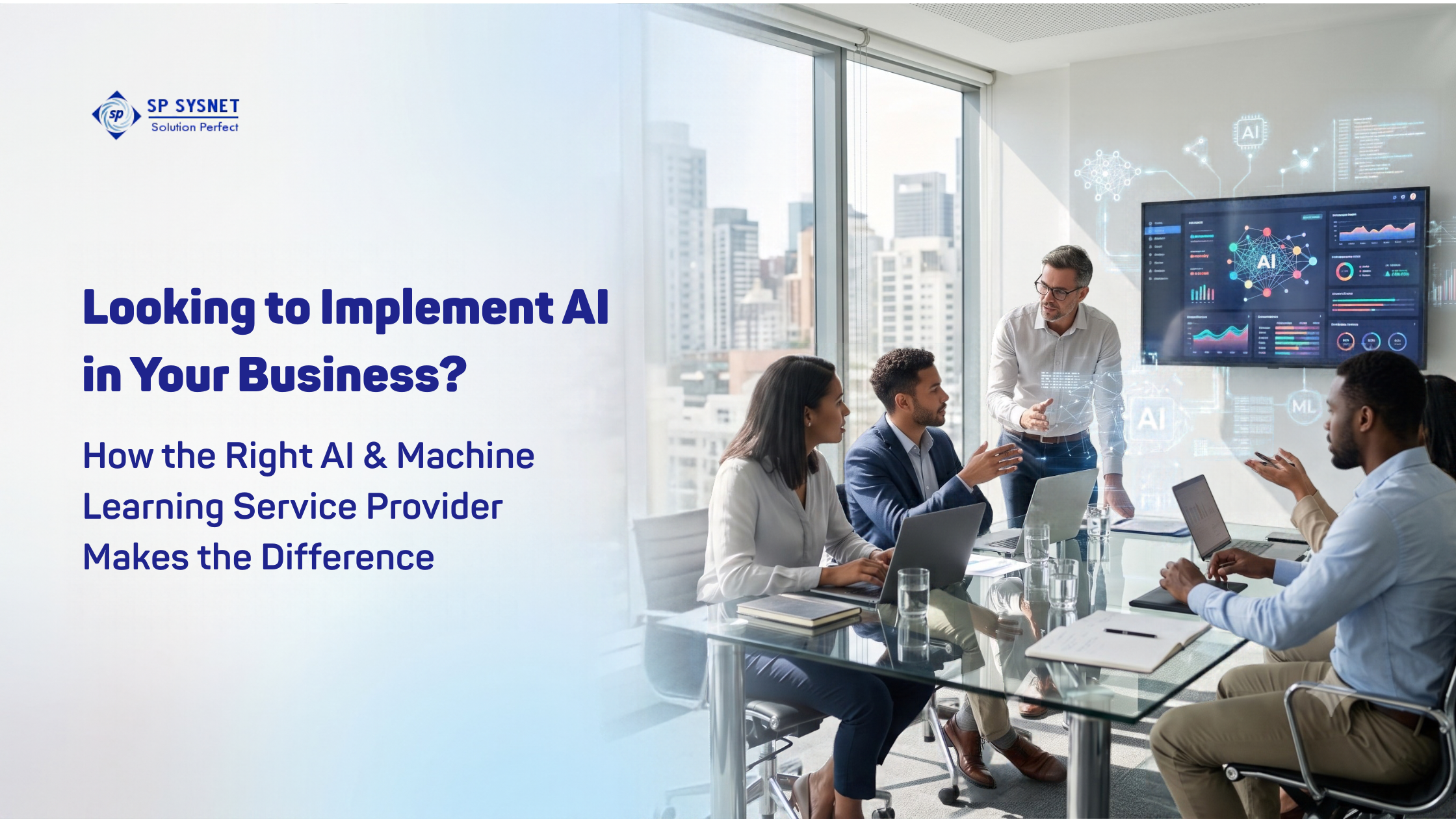
AI is no longer something businesses can simply watch from the sidelines. From automating repetitive work to improving customer experiences and analyzing large amounts of data, companies are finding practical ways to use AI in everyday operations.
But implementing AI is not as simple as buying a tool and switching it on.
Businesses need the right data, infrastructure, security, applications, and technical expertise to make AI useful. This is where choosing the right AI & Machine Learning Service Provider can make a real difference.
Start With the Business Problem, Not the Technology
One of the easiest mistakes to make with AI is starting with the technology itself.
Instead, start by asking what you actually want to improve.
Maybe employees are spending too much time on repetitive tasks. Perhaps customer support teams are dealing with a growing number of requests. Your business may also have large amounts of data that could be used for better forecasting or decision-making.
Once the problem is clear, it becomes much easier to decide whether AI or machine learning is the right solution.
A good technology partner should help with this process rather than simply recommending the latest AI tool.
Does Your Business Have the Right Data?
AI depends heavily on data.
If business data is scattered across different systems, incomplete, outdated, or poorly organized, an AI project can quickly become difficult to manage.
Before implementation, businesses should look at where their data comes from, how it is stored, who can access it, and whether it is suitable for the intended AI application.
Data preparation may not sound as exciting as building an AI model, but it is one of the most important parts of the project.
Why Does Infrastructure Matter for AI?
AI workloads can require significant computing resources, particularly when businesses are working with large datasets, complex models, or demanding machine learning applications.
The infrastructure needs to match the workload.
This could involve high-performance servers, powerful processors or accelerators, fast networking, scalable storage, and appropriate cloud resources. The right setup depends entirely on what the business is trying to achieve.
An experienced Machine Learning Service Provider can help businesses assess these requirements and create an infrastructure plan that supports the AI workload without unnecessary spending.
How Can the Right Provider Reduce AI Implementation Challenges?
AI projects often involve several moving parts. Data, applications, infrastructure, networking, security, and user access all need to work together.
Trying to manage everything without the right technical expertise can lead to delays or an expensive solution that does not deliver the expected results.
A capable service provider can help businesses move through the process in stages—from understanding requirements and preparing infrastructure to deployment, integration, testing, and ongoing support.
This is especially useful for organizations that want to introduce AI but do not have a large internal team specializing in machine learning.
What About Security and Data Privacy?
AI projects can involve sensitive business information, customer data, financial information, or internal documents. That makes security an important consideration from the beginning.
Businesses should establish appropriate access controls, data protection measures, monitoring, and governance before putting sensitive information into an AI environment.
The provider should also understand the organization’s industry requirements and help design the solution accordingly.
Security should be part of the architecture—not something added after the AI system is already running.
Should Businesses Start With a Small AI Project?
In many cases, yes.
Rather than trying to transform every department at once, businesses can start with one clearly defined use case. This makes it easier to measure the results, understand the challenges, and decide where AI can provide the most value next.
For example, a company might begin with document processing, customer support automation, demand forecasting, or internal knowledge search.
Once the first project proves successful, the same approach can be expanded to other areas.
How Do You Choose the Right AI Partner?
Look beyond a provider’s list of technologies.
Ask whether they understand your business problem, infrastructure, data environment, security requirements, and long-term goals. It is also worth checking whether they can support the project after implementation.
The right AI & Machine Learning Service Provider should be able to explain complex technology in simple terms and recommend an approach that fits your actual requirements.
At SP Sysnet, businesses can get support across IT infrastructure, servers, networking, software, cloud, and professional services, helping create the technology foundation needed for modern workloads.
Making AI Practical for Your Business
AI does not have to begin with a massive transformation project.
The better approach is to identify a genuine business problem, understand the available data, prepare the right infrastructure, and implement a solution that can be measured and improved over time.
With the right planning and technical support, AI and machine learning can become practical business tools rather than another technology trend that sounds impressive but delivers little value.
Frequently Asked Questions
What does an AI and machine learning service provider do?
An AI and machine learning service provider helps businesses plan, build, deploy, integrate, and support AI or machine learning solutions. Depending on the project, this can include data preparation, infrastructure, model development, deployment, security, and ongoing management.
Does a business need special infrastructure for AI?
It depends on the AI workload. Some applications can run on standard cloud or business infrastructure, while larger machine learning workloads may require high-performance servers, accelerators, fast networking, and scalable storage.
How can a business start implementing AI?
Start with a specific business problem rather than trying to introduce AI everywhere at once. Identify a measurable use case, assess your data and infrastructure, build a small proof of concept, and expand the solution once the results are clear.
Is AI suitable for small and medium-sized businesses?
Yes. AI is not limited to large enterprises. Smaller businesses can use AI for areas such as customer support, document processing, forecasting, automation, and data analysis, provided the solution is selected according to their budget and actual business needs.
What should I look for in a machine learning service provider?
Look for experience with your type of workload, strong infrastructure knowledge, security awareness, clear communication, and the ability to provide support beyond initial implementation. A good provider should focus on solving the business problem rather than simply selling an AI technology.